EXPRESSION OF INTEREST (EOI) To take over and operate a factory producing larvae from Black Solider Fly and Organic fertilizer at Kofisah near Nsawam
1. BRIEF BACKGROUND
The International Institute of Tropical Agriculture (IITA) is a not-for-profit institution that generates agricultural innovations to address Africa’s most pressing challenges, including hunger, malnutrition, poverty, and natural resource degradation. Collaborating with various partners across Sub-Saharan Africa, IITA improves livelihoods, enhances food and nutrition security, increases employment, and preserves natural resource integrity. IITA is a member of CGIAR, a global agriculture research partnership for a food-secure future. Please visit https://www.iita.org/ for more information on IITA.
The Black Soldier Fly (BSF) for Bio-Circular Economy and Environmental Sustainability (BBEST) project is designed to produce animal protein as an input to the chicken, pigs and fish feed and organic fertilizer value chain products through the processing of urban biowaste in Ghana. The project is located at Kofisah (EG 507-4082) within the Nsawam-Adoagyiri Municipal area. It occupies a land area of 3.00 acres, which was leased to the project by the Chief of Kofisah Nana Abegya III. The project is funded by the Norwegian Agency for Development Cooperation (Norad). The project commenced in 2021 and is scheduled to conclude in 2026. The project is managed by IITA with CSIR-IIR and BNARI as Ghanaian partners.
With a trajectory of economic growth, rapid population growth, and urbanization, on the one hand, the challenge of waste management, particularly the organic portion of the waste, is likely to persist, creating unsanitary environmental conditions that pose public health risks and contribute to greenhouse gas (GHG) emissions. On the other hand, food demands are increasing, and consumption patterns are changing, with dietary diversification into diverse vegetables, fruits, and livestock products. However, farming systems in Ghana remain unsustainable, making the trajectory of food supplies incompatible with the food demands.
This research-for-development (R4D) project aims to simultaneously address these two challenges (unsustainable biowaste management and unsustainable supply of animal feed and fertilizer) by turning biowaste challenge into an opportunity using an environmentally friendly method of breaking down biowastes into economically valuable products − animal proteins (an alternative protein source for animal and fish feed) and organic fertilizer. The project utilizes Black Soldier Fly (BSF) larvae to process vegetable and fruit waste, and other organic waste streams, such as slaughterhouse waste, into animal proteins and organic fertilizer. The project builds business cases to stimulate private investment in sustainable biowaste management and sustainable production of animal feed and organic fertilizer in Ghana and other countries.
2. OBJECTIVE OF THIS CALL
The objective of this call is to attract competent organizations and private investors with the potential to manage and operate the factory as the owner and manager from the third quarter of 2026. IITA wishes to invite expressions of interest (EOI) from interested individuals, small, medium, and corporate businesses/investors who are regulatory compliant, technically, and financially capable of taking over and managing the factory mentioned above. The primary goal is to ensure the long-term success of the project and that the impacts of donor funding are maximized even after the donor’s involvement ends.
3. A BRIEF DESCRIPTION OF THE FACTORY FACILITIES
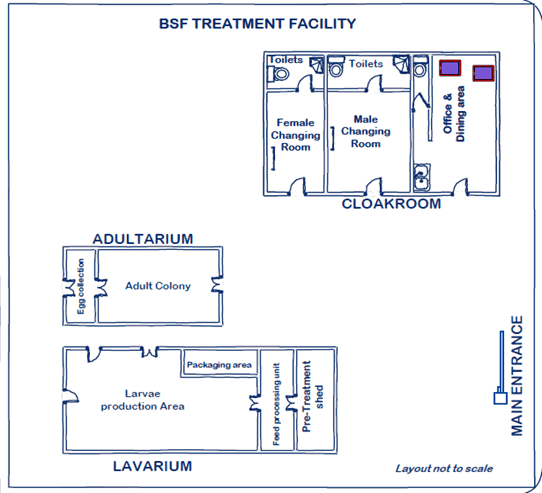
3.2. Functions of the three buildings shown in Figure 1: a) Cloakroom Hand washing facilities, Toilets, changing rooms (Female and Male), Eating area, Office
b) Larvarium *Larvae production area equipped with racks and bowls containing larvae. *The treatment area has the raw materials lodgment area and substrate processing equipment: Wet Hammer Mill (grinders), Mixer, Shaker sieve *The drying and packaging area has the larvae processing and packaging equipment Dehydrator (Dryer), Packaging material
c) Adultarium - insectary, egg collection, and incubation unit
d) Hybrid power supply system: The unit has a hybrid power supply system (solar and conventional).
e) Borehole: The unit has its own water supply system.
4. A BRIEF DESCRIPTION OF THE FACTORY OPERATIONS
The adult flies’ mate, and females lay eggs that are harvested, and neonate (‘newborn’) larvae are reared on commercial chicken feed for five days before being transferred to a substrate made of organic waste and fed till fully grown and ready to harvest.
Organic waste from the fruit processing industry, households, and markets, mixed with blood from slaughterhouses or other protein sources, is used to feed the BSF larvae. All organic materials are sourced locally. The fruit waste is ground in an electric grinder (stainless steel), dewatered, and mixed with blood in an electric mixer (stainless steel). After mixing, the substrate is dispensed in plastic containers and used to feed the larvae.
The BSF larvae are reared in plastic containers (produced by Miniplast Limited Accra). At the time of harvest, the larvae are either hand-picked or sieved in an electric shaking sieve to separate them from the remaining substrate and frass. Fully grown larvae are sanitized and killed in boiling water to ensure the larvae's surfaces are free from potential bacterial contaminants. Dead larvae are then dried in an electric dryer (aluminum trays).
The finished product is the dried BSF larvae, packed in 25 kg degradable bags, and is ready to be used as an ingredient (contains animal protein and fat) in the production of animal (broiler, layer, quail, pig) and fish feed. The second product is the organic fertilizer, which is a by-product (called frass) from larvae production. The frass is composted for three months before it is ready for use on vegetables or other crops.
5. TERMS AND CONDITIONS FOR PRE-QUALIFICATION
Companies/persons with an interest in participating in the exercise are requested to submit their Expression of Interest (EOI) with the following.
1.Company Profile to include company name, Postal and Physical location addresses, Phone number, and email addresses, Name, and title of contact person.
2.Company background and profile of the Board of Directors, if any.
3.Verifiable evidence of current or previous experience and reputation in the management of any business, preferably in manufacturing or primary goods processing or waste disposal (Not less than five (5) years)
4.Certificate of Incorporation or Registration
5.Proof of registration with Professional Regulatory Bodies where applicable
6.Letter of Creditworthiness indicating the eligible amount from a bank or another reputable/accredited credit firm.
7.Financial statement for the last three years (2023, 2024, and 2025), if available.
8.VAT Registration certificate, where applicable
9.Valid Income Tax Clearance certificate for the last three years (2023, 2024, and 2025)
10.Minimum of Three (3) Reputable Organizations as Referees
6. METHOD OF SUBMISSION OF APPLICATION
All expressions of interest are to be submitted online via T.Ankrah@cgiar.org
Please note that the above submission method is for all potential investors.
7. DEADLINE FOR SUBMISSION: 1st MAY 2026
This Request for Expression of Interest (EOI) does not constitute a solicitation, therefore IITA reserves the right to change or cancel the requirements at any time during the EOI and/or solicitation process. Your response to this EOI does not automatically guarantee that such a firm will be considered for receipt of the solicitation when issued. Only investors deemed qualified after an objective evaluation of their EOI submissions will receive acknowledgement of inclusion in the call for full proposals.